
 Photo via Carbon Brief
Sinking African coastal megacities could expose seven million people to flooding by 2050
In brief
A new study in Science Advances suggests that sinking land and rising seas could expose more than seven million people in Africa's coastal megacities to flooding by about 2050. The researchers analysed 20 large coastal cities using satellite data and sea level projections. The results are modelled estimates that hold city populations at 2020 levels and assume no coastal defences.
The report does not link the findings to the US. The study's method of using satellites to measure subsidence is described as applicable to other data-scarce regions.
What we know 6
A new study in Science Advances projects that sinking land and rising seas could expose more than seven million people in Africa's coastal megacities to flooding by mid-century.
The analysis covers 20 of Africa's most populous coastal cities and combines satellite data with sea level rise projections.
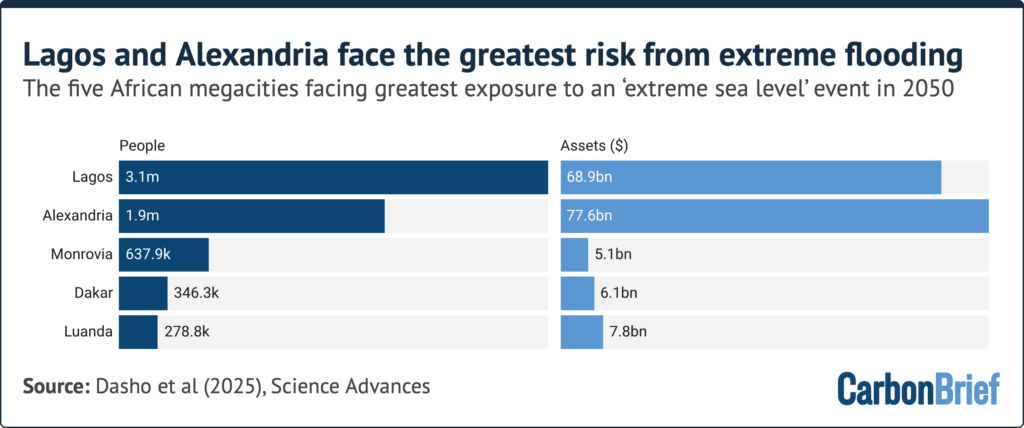
Under a moderate warming scenario, an extreme sea level event could expose about a million buildings and $180bn of assets to flooding.
Lagos and Alexandria are the most vulnerable cities in the analysis, with five million people and $150bn in assets exposed between them.
Lagos and Alexandria are sinking at about 5.2mm and 6.3mm a year, rates the authors compare with some south-east Asian megacities.
Lead author Oluwaseyi Dasho says the flood model assumes no coastal defences, so the estimates represent a worst-case physical picture.
How each outlet told it 1
How we got here
The Paris Agreement is adopted, setting a global goal to limit warming well below 2C.
The IPCC publishes the physical science part of its sixth assessment report, including sea level rise projections.
Science Advances publishes the study projecting flood exposure in Africa's coastal megacities by mid-century.
What to watch
Whether the satellite method is used to monitor subsidence in other data-scarce coastal regions
How population and urban growth change exposure estimates, which hold city populations at 2020 levels
Whether more subsidence monitoring is set up in African coastal cities, where data has been limited