
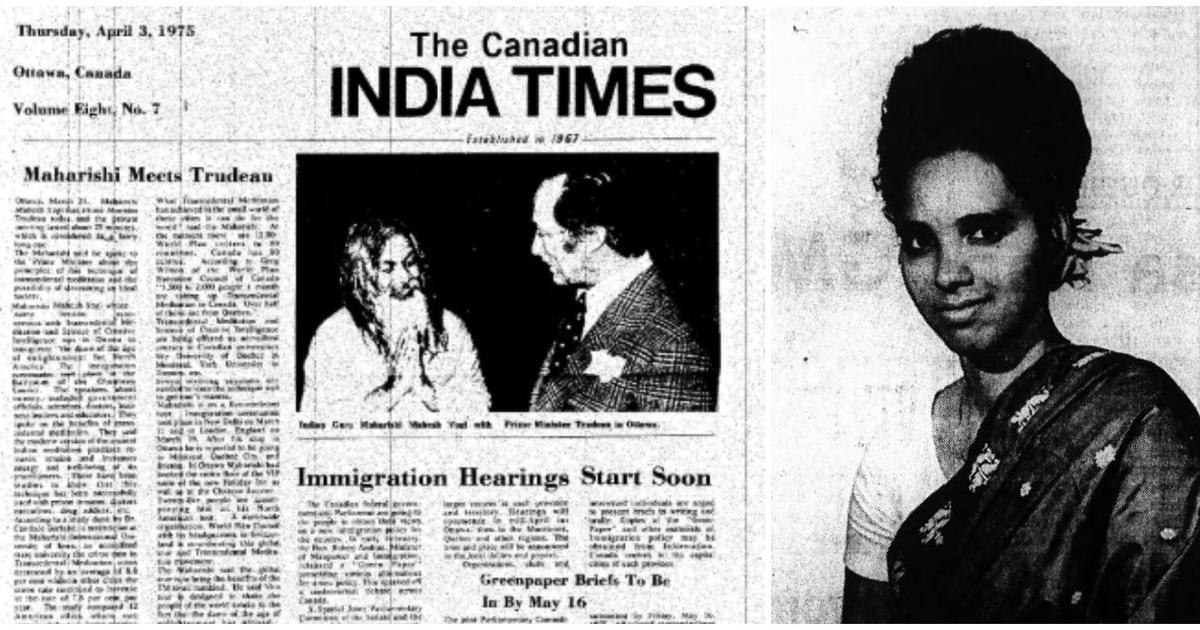
 Photo via Scroll
How a Toronto kitchen newspaper became a voice for Indians in 1970s Canada
In brief
Scroll looks back at the Canadian India Times, an English-language paper started in a Toronto kitchen in 1967. It gave Canada's Indian community a voice on local issues, including racism, and news from India. By the article's account, it had 17,000 subscribers but had not yet made a profit.
It is a historical account of how a diaspora newspaper shaped community life and public debate in 1970s Canada.
What we know 6
The Canadian India Times was founded in 1967 in a Toronto kitchen by John and Aleyamma Samuel, who had no investors or employees at the start.
The paper was launched in English for Canada's Indian community, which the article says numbered fewer than 70,000 at the time.
The paper ran matrimonial advertisements, which Aleyamma said were needed because it was very hard for educated Indian men to meet Indian women in Canada; she said the paper did not arrange matches itself.
A survey the paper sponsored of 100 federal government employees of Indian and Pakistani origin found 12.5% had experienced overt racial prejudice and 20% reported unconscious prejudice affecting promotion; the Canadian Press published the findings.
After Ugandan leader Idi Amin expelled Indians from Uganda in 1972, the paper's reporting led to the formation of the Ugandan Committee in Toronto, which helped refugees find jobs and housing.
After eight years the paper had not yet made a profit but had 17,000 subscribers across Canada and the United States.
How each outlet told it 1
How we got here
John and Aleyamma Samuel start the Canadian India Times from their kitchen in Toronto.
A report alleges racial discrimination by Ontario authorities against Indian and Pakistani doctors, and the paper campaigns on the issue.
Idi Amin expels Indians from Uganda, and the paper's reporting helps lead to the Ugandan Committee in Toronto.
The paper urges readers to cancel subscriptions to newspapers that carry racist columns by Doug Collins.
Scroll publishes a feature looking back at the newspaper's role in 1970s Canada.
What to watch
The rest of the Scroll feature, which the supplied text cuts off during its account of the 1972 Bangladesh coverage.
Whether other outlets publish further reporting or archive material on the newspaper's history.